CPV codes: how to use them to effectively identify relevant tenders

%20(1).svg)
CPV codes (Common Procurement Vocabulary) are a standardized European numerical classification used to categorize public tenders in all sectors such photovoltaic public tenders, district heating networks public procurement or public lighting tenders. While essential for initial filtering, they often suffer from coding errors, requiring semantic AI analysis to ensure no business opportunity is missed.
CPV codes (Common Procurement Vocabulary) are one of the historical pillars of public procurement structuring. They are used daily by public buyers to categorize their tenders and by companies to filter, analyze and identify relevant business opportunities.
However, despite their central role, CPV codes are often misunderstood, sometimes poorly used, and are no longer sufficient on their own to build a truly effective tender monitoring system. This limitation is particularly visible in highly technical sectors such as energy, infrastructure, mobility or environmental services, where projects are complex and span multiple domains.
This article provides a comprehensive guide to CPV codes, their intended use, their structural limitations, and explains why they must now be complemented by advanced content analysis tools and specialized tender monitoring platforms such as Deepbloo.
What is a CPV code? Definition and European origin
The CPV nomenclature acts as a universal procurement language, facilitating cross-border tender discovery despite linguistic barriers between Member States.
The CPV code (Common Procurement Vocabulary) is an official classification system created by the European Union to harmonize the description of public procurement contract objects across Member States. Its initial objective was to standardize procurement language and facilitate access to public markets.
More specifically, CPV codes were designed to improve transparency in public procurement markets, allow comparability of tenders between different countries, and make procurement searches easier regardless of the language used by the contracting authority.
Originally, CPV was therefore a purely European creation, developed for the EU internal market and for publications in the Official Journal of the European Union (OJEU / TED). Over time, however, this nomenclature has extended far beyond Europe. Today, CPV codes are used fully or partially in many non-EU countries, particularly in Africa, the Middle East and Eastern Europe, as a shared classification language for public procurement.
This international adoption makes CPV a theoretically powerful tool for identifying opportunities across borders and languages provided that it is applied consistently and correctly.
What are CPV codes used for in public procurement?
In practice, when a public buyer publishes a tender, they are required to associate one or more CPV codes to describe the nature of the expected works, supplies or services. These codes play a key operational role throughout the procurement process.
They are used to classify tenders on publication platforms such as BOAMP, TED or regional procurement portals. They also allow companies to filter procurement notices according to their activity and are part of the regulatory requirements governing public procurement transparency.
In highly technical sectors, CPV codes are used to describe very specific types of equipment or services. Typical examples of CPV in public tenders include electrical substations, SCADA systems , RTUs and remote control systems , protection relays or power lines and electrical networks. Each of these technical domains corresponds to one or several CPV categories used by buyers to describe their needs.
In theory, selecting the appropriate CPV codes should therefore be sufficient to receive tenders that perfectly match a company’s scope of activity.
Why CPV codes are essential for tender monitoring
Despite their limitations, CPV codes remain an essential foundation for any structured tender monitoring strategy. They provide a first level of market qualification and significantly reduce the volume of irrelevant tenders that companies need to review.
They are also universally used by all major procurement publication platforms, starting with BOAMP (consult our guide on optimizing your BOAMP tender search). For companies operating internationally, CPV codes act as a common procurement language across borders, making them particularly useful for identifying opportunities outside a company’s domestic market. For a deeper dive into international use cases, you can consult our guide on identifying international energy tenders.
Without CPV codes, large-scale tender monitoring would be almost impossible to structure efficiently.
The major limitation of CPV codes: sometimes approximate classification
The reliability of CPV filtering is structurally limited by the 'human factor,' as buyers often select generic or inaccurate codes for complex technical projects.
This is where one of the main weaknesses of CPV becomes evident. In real-world procurement, CPV codes are manually selected by public buyers at the time of publication. Several issues arise from this process.
Public buyers are not always technical experts in the field concerned, especially for complex or highly specialized projects. As a result, CPV codes may be selected quickly, sometimes approximately, or based on administrative habit rather than technical accuracy. In addition, complex projects often span several technical domains but are assigned only one generic CPV code.
The consequences are significant. A highly technical tender may be published with an inaccurate or overly broad CPV code. Perfectly relevant companies may never see the opportunity. Relying exclusively on CPV filtering therefore becomes risky and can lead to systematic blind spots in monitoring.
This issue is even more pronounced internationally, where procurement cultures differ and coding practices vary widely from one country to another for identical types of projects.
In practice, the effectiveness of CPV codes depends heavily on the monitoring method implemented. In manual tender monitoring, companies often rely almost exclusively on a limited number of CPV codes to filter published notices. This approach can work within a very narrow scope, but it quickly becomes risky and time-consuming as the volume of tenders increases or as projects become more complex. By contrast, automated tender monitoring makes it possible to go beyond the simple CPV logic by analysing the actual content of notices and associated documents, significantly reducing the risks linked to coding errors. To explore this methodological distinction in more detail, you can read our dedicated article: “Manual tender monitoring versus automated tender monitoring: real gains, limits and trade-offs.”
Moreover, the use of CPV codes must also be analysed in light of the differences between French public procurement markets and international markets. In France, certain highly localised sectors, such as waste collection, waste recovery or recycling activities, are subject to very local tenders, published by local authorities and often associated with generic or variable CPV codes. Internationally, these same activities may be structured differently, with other coding practices and heterogeneous levels of granularity depending on the country. This makes the identification of opportunities even more complex when relying solely on CPV codes.
Why an intelligent platform must go beyond simple CPV logic
Modern tender monitoring must shift from 'code-based' to 'content-based' analysis to capture opportunities hidden behind vague administrative classifications.
For these reasons, CPV codes should never be used in isolation. A modern tender monitoring platform must be able to go beyond administrative classification and analyze the real substance of a tender.
This means examining the title, description and attached documents, understanding what the project is actually about, and, where necessary, reassigning or enriching CPV classifications based on semantic analysis of the content.
This is precisely the approach adopted by Deepbloo. Beyond the CPV code declared by the buyer, the platform analyzes tender texts, technical documents such as DCEs and CCTPs, and domain-specific terminology to accurately qualify each opportunity.
This approach is essential to avoid missing poorly coded tenders, detect hidden opportunities that would otherwise go unnoticed, and dramatically improve the relevance of monitoring results. To better understand this methodology, you can read our article: What is a tender monitoring platform?
Combining CPV codes, semantic analysis and weak signals
The most effective tender monitoring strategies combine several complementary layers of analysis. CPV codes act as a first structural filter, semantic analysis allows for a deeper understanding of tender content, and weak-signal detection enables companies to anticipate projects before formal tenders are published.
This multi-layered approach not only helps identify existing procurement opportunities but also supports upstream market intelligence. It is the foundation of advanced monitoring strategies described in our articles on biodiversity-related tenders, urban mobility and transport services, and energy efficiency and building performance.
Such an approach is particularly critical in technical sectors like energy and infrastructure, where project complexity far exceeds what a single administrative code can express.
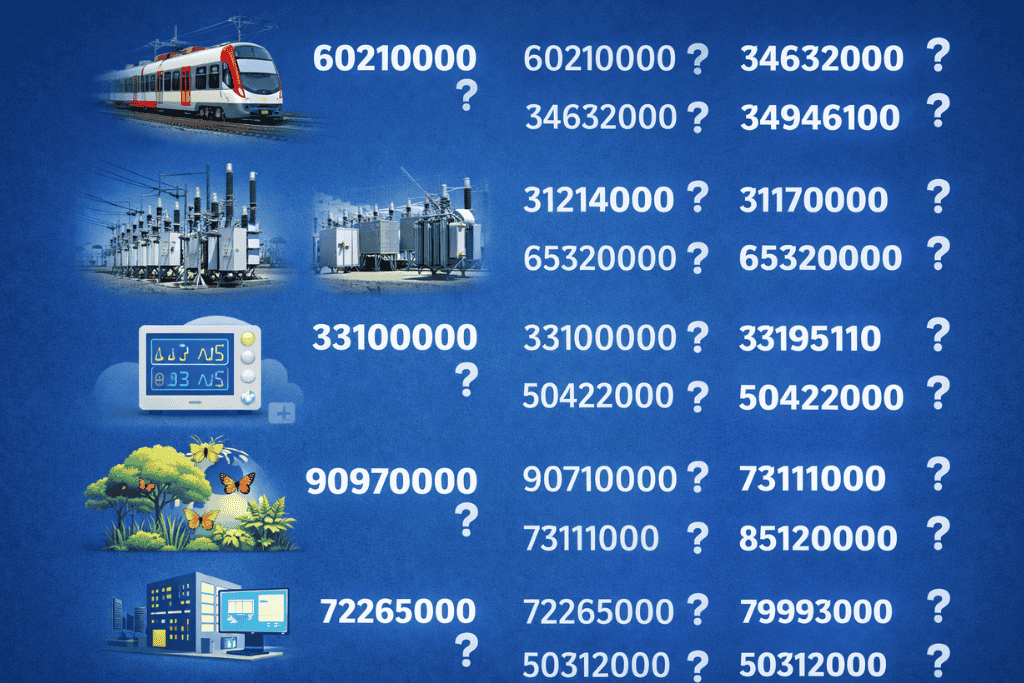
CPV as a common language… but imperfect at a global scale
International CPV consistency is a myth; identical projects in energy or waste management are often coded with different levels of granularity depending on the country’s procurement culture.
CPV remains extremely valuable because it provides an international reference framework that is independent of language. However, this strength is also its weakness. Depending on the country and the contracting authority, buyers may use different CPV codes for the same commodity, apply varying levels of granularity, or rely on generic and overly broad categories.
This variability reinforces the importance of using platforms capable of understanding the actual substance of a project rather than relying solely on its administrative label.
3 Steps to Optimize your CPV Strategy
- Identify your Core & Peripheral Codes: Map your main activity (e.g., Solar PV) but also broader infrastructure codes where your lots might be hidden.
- Audit past "Missed" Tenders: Check which CPV codes were used for contracts you won or missed to refine your alert profile.
- Layer with Keywords: Never use CPV alone. Combine them with technical terms (e.g., "Inverter", "HVDC", "BESS") via an automated platform like Deepbloo to bridge the coding gap.
Conclusion: CPV codes, an essential foundation… but insufficient on their own
CPV codes are a fundamental component of tender monitoring. They structure public procurement, facilitate search and provide a shared language at both European and international levels.
However, real-world usage clearly highlights their limitations: coding errors, approximations, cultural differences between countries and increasing project complexity. Relying exclusively on CPV codes therefore exposes companies to a significant risk, missing opportunities that are perfectly aligned with their expertise.
In this context, relying on a tender monitoring platform makes it possible to overcome the limitations of CPV codes, analyze the actual content of public tenders, and more effectively anticipate opportunities in France.
In summary:
- CPV = Foundation: Necessary for structure but dangerous if used alone.
- Human Error: Buyers aren't always technical experts; codes are often approximate.
- The Solution: Combine CPV, technical keywords, and Deepbloo’s AI for 100% coverage.
6. FAQ
Are CPV codes mandatory for all tenders?
Yes, for all contracts published in the OJEU (TED) and for most formal national procedures in France (BOAMP).
Can a tender have multiple CPV codes?
Yes, a buyer can assign one main code and several supplementary codes to describe different aspects of a project.
Why am I missing tenders despite having the right CPV alerts?
This is usually due to "mis-coding" by the buyer or the use of a generic code (like "Construction works") instead of a specific technical one.
How does Deepbloo improve CPV accuracy?
Deepbloo uses Semantic Analysis to read the full tender documentation, automatically flagging relevant contracts even if the assigned CPV code is incorrect.


%20(1).jpg)


.jpeg)
.png)


.png)
.png)