Building energy efficiency: how to identify tenders related to energy performance

%20(1).svg)
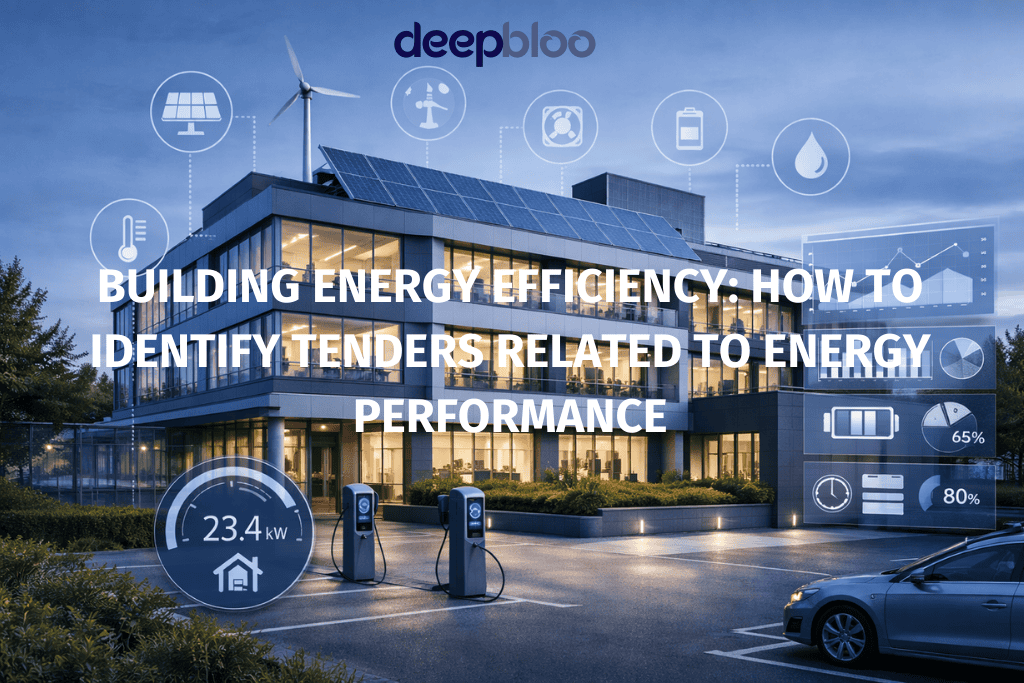
Identifying energy efficiency tenders in France requires tracking Building Management Systems (BMS/GTB), EV charging infrastructure (EVSE), and regulatory compliance projects driven by the BACS Decree. These opportunities are fragmented across 300+ national and regional procurement platforms.
This article was written in collaboration with Hervé Otenga, COO of SPE Connect, a leading French player in energy optimization and the digital transformation of buildings, specializing in energy performance, Building Management Systems (BMS), EV charging infrastructures (EVSE) and advanced control systems.
Why energy efficiency is generating more and more public and private tenders ?
Building energy optimization has shifted from a voluntary saving measure to a mandatory regulatory requirement for the French tertiary and industrial sectors.
Energy optimization of buildings and infrastructures has now become a key lever to reduce energy consumption and, consequently, energy bills. Companies specializing in this field support local authorities, the tertiary sector and industry in deploying tools capable of measuring, analyzing and controlling energy uses.
These solutions have a clear objective: consume less, optimize better and anticipate deviations. They rely on building management system (BMS) technologies and on controllers capable of supervising all the equipment on a site, from heating and air conditioning to lighting and specific installations.
To better understand how to identify these projects at an early stage, you can consult our article: How to identify renewable energy projects in France.
BMS and automation tenders: key levers for building energy performance
BMS and automation solutions tenders are based on a simple idea: transforming a building into an intelligent system capable of self-optimization.
They make it possible, for example, to:
- measure consumption (lighting, heating, cooling, technical equipment),
- control installations from a centralized platform,
- automatically detect anomalies and deviations,
- generate alerts for overconsumption,
- propose corrective actions through data analysis.
This operation relies on controllers integrated into the building, capable of continuously collecting information and acting in real time. Once installed, they provide a detailed view of the site’s energy behavior and facilitate operational decision-making.
To go further on solar projects and their early-stage identification, you can read our article: How to identify photovoltaic projects in France.
Energy management tenders: photovoltaics, self-consumption and charging infrastructures (EVSE)
The convergence of photovoltaic production and electric vehicle charging (EVSE) is creating a new generation of hybrid tenders focused on real-time energy load balancing.
The rise of photovoltaics and electric vehicle charging infrastructures is radically transforming energy management needs. Solar power plants produce variable energy that must be efficiently integrated into site consumption, while EVSE generate significant and often simultaneous power demand.
Specialized companies are therefore developing solutions capable of:
- monitoring photovoltaic production (see examples of photovoltaic public tenders) in real time,
- optimizing self-consumption (see examples of self-consumption public tenders) through control strategies,
- limiting power overruns during vehicle charging (see example of vehicle charging infrastructure public tenders)
- arbitrating between storage (examples of storage public tenders), local consumption and grid injection (grid public tenders),
- detecting faults on inverters, charging stations or electrical panels.
In this context, controllers become the core of the energy system. They make it possible to balance production, consumption and charging while minimizing costs. Local authorities, EVSE operators and industrial companies are therefore increasingly issuing tenders to equip themselves with supervision platforms capable of ensuring this control.

The BACS Decree: a regulatory framework structuring energy efficiency tenders
The BACS Decree acts as a primary market catalyst, legally mandating the installation of automated control systems (BMS) in all large-scale French tertiary buildings by 2025-2027.
The BACS Decree has profoundly transformed the energy performance market. It now requires all new tertiary buildings, and progressively the entire existing building stock, to be equipped with an automation and control system capable of:
- monitoring consumption,
- controlling installations,
- automatically optimizing uses,
- triggering corrective actions in the event of deviation.
In practical terms, any new building permit in the tertiary sector must integrate a BMS system.
This applies to public buildings as well as shops, healthcare facilities, offices or educational buildings.
This regulatory framework creates an extremely strong dynamic: local authorities must comply rapidly, which generates a significant volume of studies, modernization contracts, automation projects or equipment renewal contracts.
Energy performance tenders: a fast-growing market for specialized companies
The diversity of contracting authorities, from hospitals to universities, makes manual monitoring ineffective for capturing specialized energy performance lots hidden within general works.
The implementation of the BACS Decree leads to a multiplication of tenders covering:
- the installation or modernization of BMS,
- the integration of metering or control devices,
- supervision-assisted energy renovation,
- compliance of technical equipment,
- advanced energy audits,
- photovoltaic and EVSE supervision,
- maintenance and operation of installed solutions.
For companies specializing in energy performance, identifying these tenders has become a strategic challenge.
They are issued by a wide range of stakeholders: municipalities, inter-municipal authorities, departments, regions, hospitals, universities, public housing authorities, semi-public companies, etc.
Faced with this dispersion, it is essential to have a centralized platform allowing to:
- consolidate all relevant tenders,
- filter by sector (BMS, EVSE, photovoltaics, energy performance),
- detect opportunities at an early stage,
- automate monitoring and analysis.
To understand how to set up an effective monitoring system, you can consult our article: How to set up a tender monitoring system in France.And to go further on automating this monitoring, also discover our article: How AI is revolutionizing tender monitoring in France and internationally.
Deepbloo enables companies to navigate the complexity of the BACS Decree by analyzing the actual technical specifications (CCTP) within broad construction tenders. The platform automatically extracts specific lots for BMS, automation, and energy monitoring that are often invisible to traditional keyword-based searches.
3 Steps to Capture Energy Efficiency Projects
- Monitor Building Permits: Track new tertiary projects during the design phase to anticipate the mandatory BMS requirements imposed by the BACS Decree.
- Use Technical Keywords: Don't just search for "energy"; target specific terms like "Regulation," "Sub-metering," "BMS," or "Smart Grid" within the tender documents.
- Leverage Semantic Analysis: Use a platform like Deepbloo to detect if a "Global Renovation" tender contains a specific hidden lot for energy performance, which is often missed by standard CPV filters.
Conclusion – Tender monitoring, a central challenge to capture energy efficiency projects
The energy transition, the development of photovoltaics, the growth of EVSE and the application of the BACS Decree are strongly accelerating demand for energy performance solutions. This movement creates a continuous flow of public and private tenders, offering exceptional opportunities for companies capable of delivering control, supervision and automation solutions.
In this context, having a centralized, reliable and intelligent monitoring system becomes essential to capture high-potential projects.
To further refine the identification of these markets and better filter tenders related to energy efficiency, it is also essential to understand how CPV codes are used and what their limitations are, as explained in our article “CPV codes: how to use them to effectively identify relevant tenders.”
In this context, relying on a tender monitoring platform makes it possible to structure the tracking of building energy efficiency–related projects, centralize public and private tenders, and more effectively anticipate opportunities in France.
In summary:
Regulatory Driver: The BACS and Tertiary Decrees are the primary engines for new tenders in France.
Technological Shift: Demand is moving toward integrated "Smart Building" and EVSE solutions.
Competitive Edge: Success depends on identifying technical lots hidden within massive infrastructure projects.
FAQ: Energy Efficiency & Building Tenders
What is the BACS Decree in French public procurement?
It is a legal obligation for tertiary buildings to be equipped with automation and control systems by 2025 or 2027, generating a massive flow of BMS-related tenders.
How do I find EV charging (EVSE) tenders in France?
These are often bundled with energy renovation projects or public parking upgrades and published on BOAMP or regional buyer profiles.
What are the common CPV codes for energy efficiency?
Frequent codes include 71314300 (Energy efficiency advisory services) and 45232141 (District heating works), though they are often too generic for specialized monitoring.
Why is AI necessary for monitoring energy performance tenders?
Because energy efficiency lots are often "embedded" within larger works contracts. AI extracts these specific opportunities automatically by reading the full documentation.


%20(1).jpg)


.jpeg)
.png)


.png)
.png)


.png)



%20(1).png)